Anti-Money Laundering as a System Architecture
How information transformation, reconstruction, and actor misalignment shape cost, risk, and system performance.
By CHIHANI Rachid — April 2026 · 20 min read

Anti-Money Laundering (AML) operates as a system architecture through which financial activity is observed, interpreted, and acted upon at scale. Its performance is not defined by any single component, but by how information is transformed, how understanding is constructed, and how decisions are applied across a distributed set of actors.
The system achieves scale by transforming financial activity into structured representations. Customer data and transactions are captured in standardized formats that enable monitoring across large datasets. Detection mechanisms evaluate these representations through rules, scenarios, and models to identify patterns of interest.
This structure enables coverage. It also introduces a defining constraint.
Transformation and detection convert continuous, context-rich activity into bounded signals. These signals support systematic processing, but they do not preserve the full continuity and context of the underlying activity. Understanding is therefore not produced directly by detection.
It is constructed through reconstruction.
Investigation expands structured signals into contextual understanding by assembling information across systems, connecting relationships, and interpreting activity. This process bridges the gap between scalable monitoring and decision-ready insight. It requires time, expertise, and coordination across fragmented data environments.
As a result, operational effort concentrates where reconstruction occurs.
This concentration defines the economic structure of the system. Cost follows reconstruction. Investigation absorbs a significant share of resources because it converts signals into context. Detection operates at scale through infrastructure. Reconstruction operates case by case through effort.
Risk is organized through a different mechanism.
It concentrates at the point of decision, where the system commits to an outcome. Decisions determine whether activity is escalated, reported, or closed, and they carry regulatory, legal, and reputational consequences. Cost and risk are therefore structurally separated. Effort accumulates upstream in reconstruction, while risk materializes downstream in decision-making.
Across these stages, the system distributes its core capabilities. Visibility is generated through data systems and institutional records. Interpretation is developed through analysis and reconstruction. Authority is exercised through institutional decisions and regulatory oversight.
These capabilities do not converge within a single actor.
Financial institutions, data platforms, analytical systems, operational teams, and regulators each operate with partial visibility, partial interpretation, and defined authority. The system functions through the coordination of these roles.
This introduces a second defining constraint.
Visibility and authority are structurally misaligned. Actors with the ability to act do not fully observe the system. Actors with extended visibility do not hold authority to apply system-wide decisions. Interpretation operates between these layers, connecting what is observed to what can be decided.
System performance depends on alignment.
The effectiveness with which visibility, interpretation, and authority connect determines how accurately activity is understood and how consistently decisions reflect underlying behavior. As alignment becomes more complex, reconstruction effort increases, coordination becomes more demanding, and system performance depends increasingly on the ability to connect distributed capabilities.
These dynamics are observable in practice.
Detection systems generate high volumes of alerts relative to confirmed outcomes. Investigation absorbs the majority of operational effort and cost. Decision volumes are smaller but carry disproportionate risk exposure. Data fragmentation across systems and institutions increases reconstruction complexity and variability in case handling.
These patterns are not anomalies. They reflect the structure of the system.
This structure defines where leverage exists.
Improvements in data quality and detection refine visibility and signal generation. Enhancements in integration and workflow reduce reconstruction effort and improve throughput. Stronger decision frameworks increase consistency and defensibility. Alignment across stages and actors determines how effectively these improvements translate into performance.
The system does not reward isolated optimization. It rewards alignment.
AML therefore operates through a balance between scale and understanding. Transformation enables coverage. Reconstruction enables interpretation. Decision applies accountability. Capabilities remain distributed, and alignment determines outcomes.
Understanding this architecture provides a basis for evaluating performance, prioritizing investment, and positioning within the system. It clarifies where effort is required, where cost accumulates, where risk is carried, and how coordination shapes results.
The system is not defined by its components alone.
It is defined by how they connect.
Anti-Money Laundering operates as a system architecture through which financial activity is observed, interpreted, and acted upon at scale. It defines how institutions manage exposure, how regulators assess outcomes, and how decisions are formed under conditions of uncertainty and accountability.
The system achieves scale by transforming financial activity into structured representations. These representations enable consistent monitoring across large datasets and support the identification of patterns of interest. At the same time, transformation constrains contextual completeness, continuity, and relational depth. What the system processes is not the full underlying activity, but a structured representation of it.
Detection mechanisms operate on these representations by converting continuous behavior into discrete signals. Alerts are generated through rules, thresholds, and models that identify patterns within defined parameters. This process enables coverage. It also shapes what becomes visible by compressing activity into signals that can be processed systematically.
Once a signal is generated, the system transitions into investigation. At this stage, structured outputs are expanded into contextual understanding through reconstruction. Information is retrieved across systems, relationships are assembled, and activity is interpreted within its broader context. This process is not embedded within detection. It is carried through coordinated effort across data sources, analytical tools, and human judgment.
This transition defines a central characteristic of the system: understanding is not directly produced by detection. It is reconstructed from structured signals through effort.
As a result, operational effort is not evenly distributed. It concentrates where structured information must be expanded into context. Investigation becomes the point at which the system converts scalable detection into decision-ready understanding.
This concentration of effort defines the system’s economic structure. Cost follows reconstruction. Investigation absorbs a significant share of operational resources because it requires time, expertise, and coordination across fragmented information sources.
Risk is organized differently. It materializes at the point of decision, where the system commits to an outcome. Whether activity is escalated, reported, or closed determines regulatory exposure, legal accountability, and reputational impact. Cost and risk therefore do not coincide. Effort concentrates upstream in reconstruction, while risk concentrates downstream in decision-making.
Across these stages, the system distributes its core capabilities. Visibility is generated through data systems and institutional records. Interpretation is developed through analysis and investigation. Authority is exercised through institutional decisions and regulatory frameworks. Each capability operates with depth within its domain.
These capabilities do not converge within a single actor. They are distributed across institutions, platforms, and authorities, each operating with partial visibility, partial interpretation, and partial control. This distribution introduces a coordination dynamic that shapes system performance.
The connection between visibility and authority becomes the defining constraint. Those who can act do not fully observe the system. Those who observe do not fully control it. Interpretation operates between these layers, bridging structured signals and accountable decisions.
System performance therefore depends on alignment. When visibility, interpretation, and control connect effectively, decisions reflect underlying activity with clarity. As alignment becomes more complex, reconstruction effort increases, coordination becomes more demanding, and system performance depends increasingly on the ability to connect distributed capabilities.
This structure defines how the system operates:
These characteristics are not incidental. They are inherent to how the system achieves scale, produces understanding, and applies control.
Financial activity originates outside the system as a continuous structure. It reflects sequences of behavior, relationships between actors, and contextual elements that give meaning to each interaction over time. This structure is not directly accessible to AML systems.
To operate at scale, the system transforms this continuous activity into structured representations. Customer identity frameworks define entities through attributes such as identifiers, classifications, and profiles. Transaction systems represent activity as discrete events, capturing elements including amounts, timestamps, counterparties, channels, and instruments. These representations establish a consistent and processable view of activity across large datasets.
This transformation enables comparability and systematic monitoring. It defines how activity can be observed, categorized, and analyzed within institutional and regulatory frameworks.

At the same time, transformation introduces a structural condition. Continuous behavior is represented through discrete records. Relationships are captured through available linkages. Context is expressed through the structure and coverage of the data. Elements that extend beyond these representations remain outside the system’s immediate field of observation.
Detection operates on these structured representations. Rules, scenarios, thresholds, and models convert structured inputs into signals that identify patterns of interest. This process introduces a second layer of transformation. Continuous sequences of activity are evaluated within defined parameters and expressed as discrete alerts.
Through this process, detection performs a structural compression. It reduces multi-dimensional activity into signals that can be processed consistently. Temporal continuity is segmented. Contextual elements are filtered through defined criteria. The system produces signals that are optimized for coverage and processability rather than for preserving the full structure of the underlying activity.
The output of detection therefore represents a bounded view of activity. It identifies patterns that meet defined conditions. It does not represent the full continuity or context from which those patterns emerge.
This establishes a distinction between two forms of information within the system.
Structured representations define what is captured and processed. They provide a consistent foundation for monitoring and comparison. Contextual understanding extends beyond these representations. It reflects relationships, sequences, and conditions that are assembled through interpretation.
The system operates through the interaction between these two forms. Structured data supports scale. Contextual formation supports understanding.
When a signal is generated, this interaction becomes operational. Investigation expands the structured signal by assembling additional information across systems and sources. Relationships are reconstructed, sequences are examined, and activity is interpreted within its broader context.
This expansion does not restore the original continuous structure of activity. It constructs a contextual representation based on available data, analytical methods, and professional judgment. The original continuity remains outside the system. What is produced is a decision-ready understanding derived from structured inputs and reconstructed context.
The movement from transformation to context formation therefore defines a central dynamic of the system. Structured representations enable detection. Detection produces signals through compression. Investigation expands these signals into contextual understanding through reconstruction.
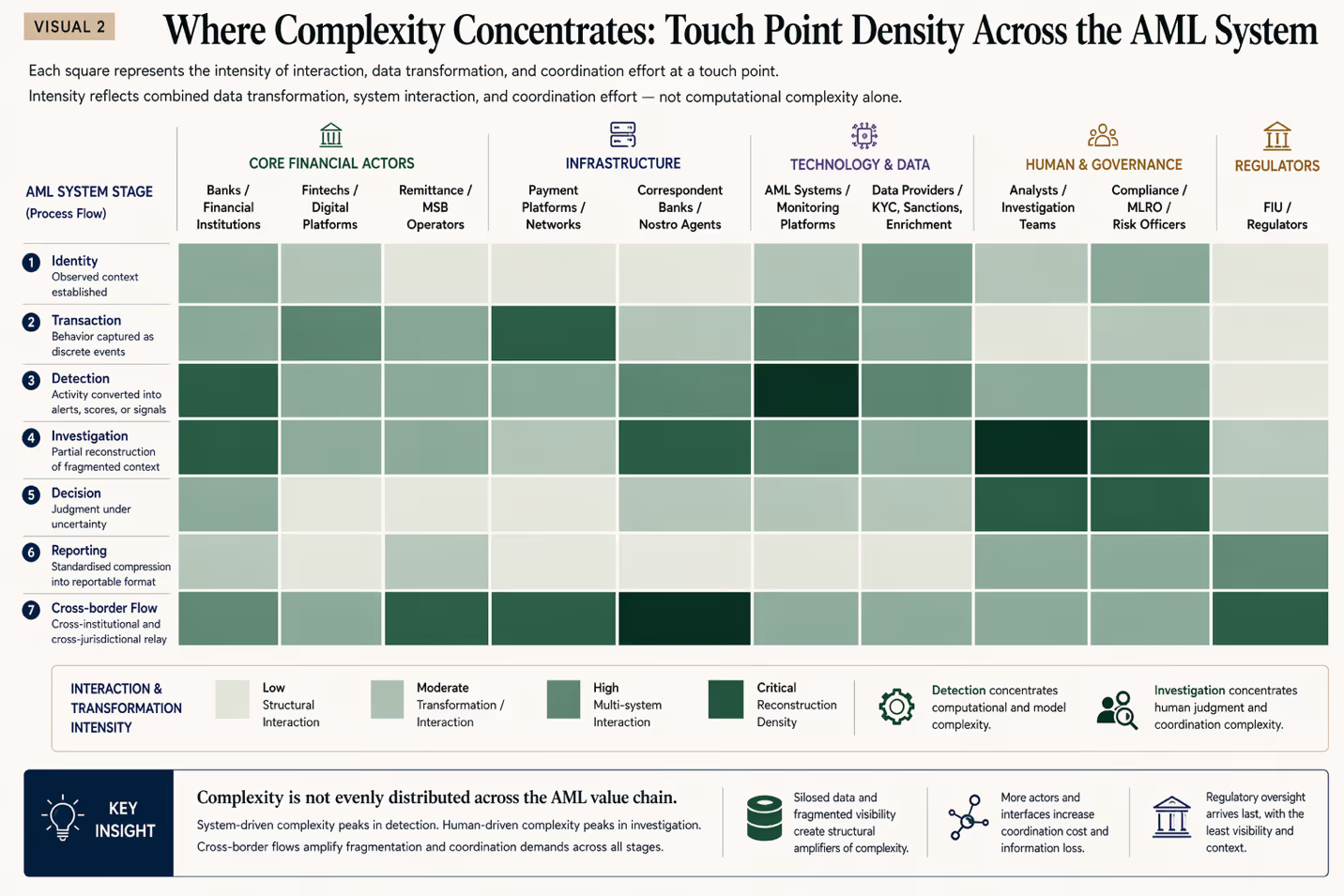
This dynamic shapes how information flows through the system. It determines what is visible, what must be interpreted, and how understanding is formed under structural constraints.
The transformation of financial activity into structured representations enables the system to operate at scale. Detection converts these representations into signals that can be processed consistently across large volumes of data. This sequence establishes coverage.
It also defines a boundary.
Detection produces signals that identify patterns within defined parameters. These signals represent a structured view of activity. They do not, by themselves, provide sufficient context to support a decision. The system must therefore transition from structured detection to contextual understanding.
This transition is carried through reconstruction.
Reconstruction can be defined as the process through which structured signals are expanded into contextual representations by assembling information across multiple sources. It involves retrieving data from different systems, aligning records, examining sequences of activity, identifying relationships, and interpreting these elements within a broader context.
This process does not occur within a single structure. It requires traversal across fragmented representations of activity. Customer information, transaction histories, external data sources, and analytical outputs are distributed across systems and interfaces. Reconstruction brings these elements together to form a coherent view of a case.
At this point, the system reveals a defining characteristic.
Understanding is not produced at the point of detection. It is constructed through reconstruction.
This construction requires both time and cognitive effort. Analysts must interpret signals, assess relevance, connect disparate elements, and form a narrative that supports decision-making. Each step depends on the accessibility, quality, and coverage of the underlying information.
Reconstruction therefore introduces a second layer of work within the system.
The first layer operates through structured processing. It captures and evaluates activity at scale. The second layer operates through contextual assembly. It expands structured signals into decision-ready understanding.
Operational effort concentrates in this second layer.
Each alert generated by detection initiates a reconstruction process. The volume of alerts defines the volume of reconstruction. The complexity of each case defines the depth of effort required. As a result, workload is not evenly distributed across the system. It accumulates where signals must be expanded into context.

This concentration is driven by structural factors:
These conditions define the effort required to move from signal to understanding.
The system therefore scales in two distinct ways.
Structured processing scales with data volume. Detection operates across large datasets with consistent rules and models. Reconstruction scales with cases. Each case requires individualized effort to assemble context and form interpretation.
This distinction defines the operational experience within AML.
Monitoring systems can process increasing volumes of activity with incremental infrastructure cost. Investigative processes require proportional increases in human effort as case volume and complexity grow. The relationship between detection and reconstruction therefore determines how workload evolves.
Increased detection sensitivity expands coverage. It also increases alert volume. Each additional alert introduces a reconstruction requirement. Operational effort expands accordingly.
This dynamic establishes a direct link between system design and workload.
Reconstruction is not an auxiliary function. It is the structural bridge that converts scalable detection into decision-ready understanding. It defines where time is spent, how expertise is applied, and how operational capacity is consumed.
The concentration of effort within reconstruction defines how resources are consumed across the system. It also establishes how cost and risk are distributed.
Detection operates continuously across large datasets. Its cost is embedded in infrastructure, data processing, system maintenance, and model governance. This cost scales with data volume, coverage, and system complexity. It is predominantly structural and incremental.
Reconstruction operates differently. It is initiated at the level of individual cases. Each alert requires retrieval of information, alignment of records, interpretation of activity, and formation of a coherent narrative. This work is time-intensive and dependent on expertise, access to data, and coordination across systems.
Cost therefore follows reconstruction.
Investigation absorbs a significant share of operational resources because it converts structured signals into contextual understanding. Time spent per case, variability in complexity, and the volume of alerts define its economic weight. As alert volume increases, reconstruction demand increases proportionally. The system translates detection output directly into investigative workload.
This establishes a clear economic structure. Monitoring systems scale through infrastructure. Investigation scales through effort.
At the same time, the system organizes risk through a different mechanism.
Risk is defined here as the exposure associated with a decision, including regulatory, legal, and reputational consequences. It materializes at the point where the system commits to an outcome.
Decision-making represents the moment at which interpretation is translated into action. Whether a case is escalated, reported, or closed determines how the institution is positioned under regulatory scrutiny. Decisions must be justified, documented, and defensible within defined frameworks.
Risk therefore concentrates at the point of decision.
This creates a structural separation between cost and risk.

Reconstruction absorbs effort in order to form understanding. Decision applies that understanding and carries accountability. These elements operate in sequence, yet they do not coincide in their impact on the system.
Cost accumulates upstream, where information must be assembled and interpreted. Risk materializes downstream, where outcomes are defined and evaluated.
This separation has direct implications for system behavior.
Operational teams manage workload by allocating resources to investigation. Institutions manage exposure by controlling decision quality and consistency. The system therefore requires both capacity to reconstruct context and discipline in applying decisions.
The relationship between detection and reconstruction further reinforces this dynamic.
Increased detection sensitivity expands coverage and improves the likelihood of identifying relevant activity. It also increases alert volume. Each additional alert introduces a reconstruction requirement, expanding operational cost without directly increasing decision-level risk.
Conversely, decision quality determines how risk is realized. A single decision can carry significant consequences, independent of the volume of cases processed upstream.
This establishes two distinct scaling dynamics within the system.
Cost scales with reconstruction demand. Risk scales with decision exposure.
Understanding this distinction clarifies how resources are allocated and how performance is evaluated. It explains why operational investment concentrates in investigation, while governance, oversight, and accountability concentrate at the point of decision.
The system therefore operates with a dual structure:
These structures are interconnected through the flow of information, yet they remain distinct in how they shape system outcomes.
The AML system operates through a network of actors, each contributing to observation, analysis, and decision-making within a defined scope. Financial institutions, data platforms, analytical systems, operational teams, and regulatory bodies form an interconnected structure that supports monitoring, interpretation, and control.
Within this structure, the system distributes its core capabilities across actors.
Visibility is generated through data systems and institutional records. Financial institutions observe customer activity through onboarding information, transaction systems, and internal histories. Data providers and platforms extend this view through aggregation, enrichment, and analytical capabilities. Each source contributes a partial perspective on financial activity.
Interpretation is developed through analytical processes and investigation. Detection systems identify signals based on structured criteria. Analysts expand these signals into contextual understanding by assembling information across systems, connecting relationships, and forming case-level interpretations.
Authority is exercised through decision-making and enforcement. Financial institutions determine how cases are resolved within their operational frameworks. Regulators define compliance standards, evaluate institutional behavior, and apply enforcement actions where required.
Each capability operates with depth within its domain. Each is necessary for the system to function.
These capabilities do not converge within a single actor.
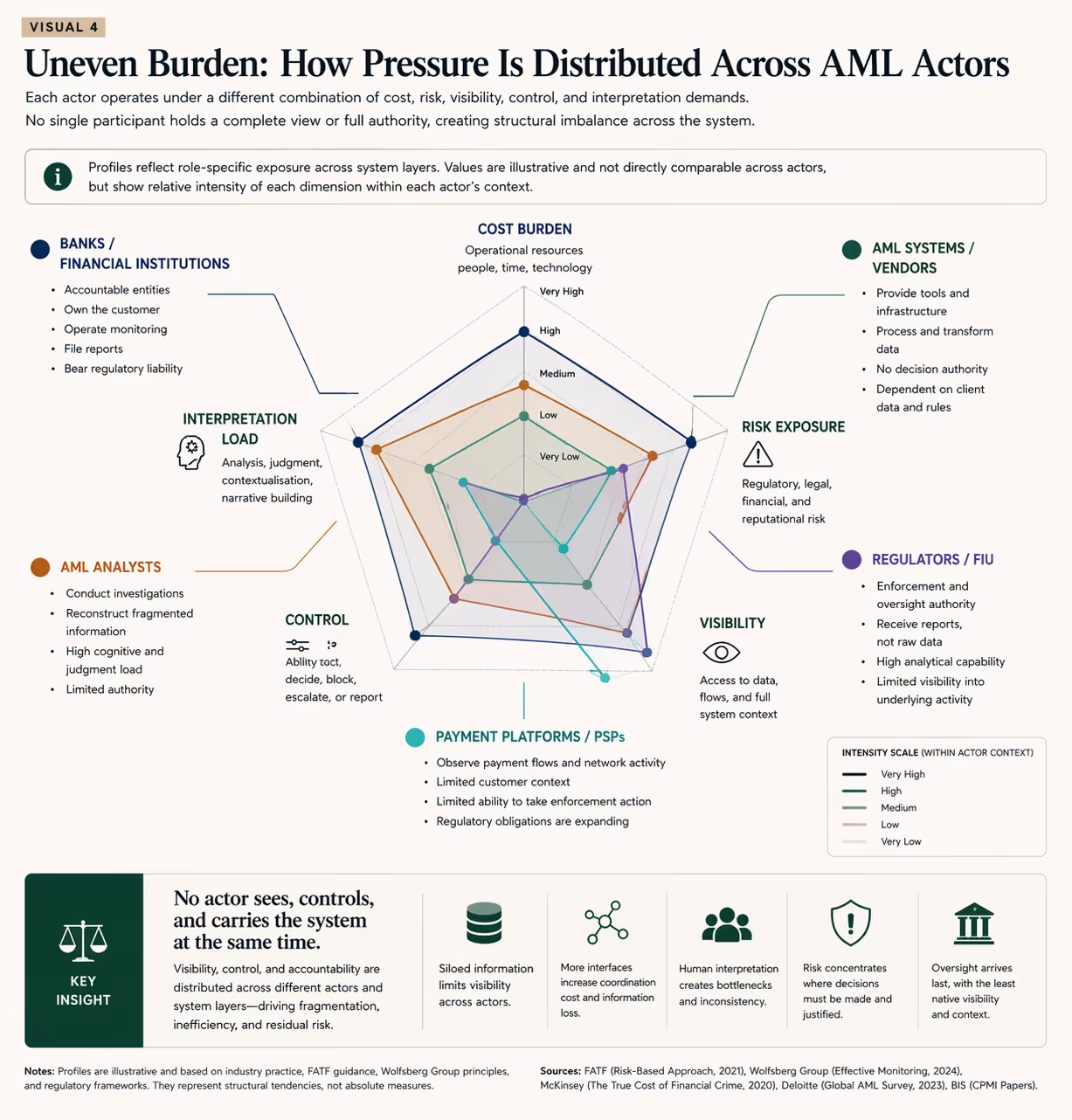
Financial institutions operate with direct exposure to customer activity and carry the responsibility for investigation and reporting. They hold operational control at the case level, while operating within defined regulatory frameworks. Their visibility is bounded by their own data and systems.
Data platforms and external providers extend visibility by aggregating information across sources. They enhance analytical capability and broaden the observable field of activity. They do not hold decision authority or regulatory accountability.
Analytical systems process structured data and generate signals that support monitoring at scale. They operate within defined parameters and contribute to detection. They do not interpret context or apply decisions independently.
Operational teams, including analysts, operate at the level of individual cases. They assemble context, interpret activity, and support decision-making. Their role is central to forming understanding. Their authority is limited to recommendation and structured escalation.
Regulators operate at the level of oversight and enforcement. They define frameworks, evaluate outcomes, and apply authority across institutions. Their visibility is derived from reported activity and aggregated information rather than direct access to underlying transactional flows.
This distribution creates a system composed of specialized roles, each contributing a defined function.
It also introduces a structural condition.
Each actor operates with a partial combination of visibility, interpretation, authority, cost, and risk. No actor holds all capabilities simultaneously. Each perspective is shaped by the data available, the systems in use, and the scope of authority granted.
The system therefore functions through distributed capability.
Visibility is fragmented across data sources and institutions. Interpretation is constructed at the operational level through reconstruction. Authority is applied at decision points within institutions and at the level of regulatory oversight. Cost is concentrated within institutions that perform investigation. Risk is carried at the point of decision and evaluated within regulatory frameworks.
These elements do not align within a single actor. They are distributed across the system.
This distribution defines how coordination must occur.
Outputs from one actor form inputs for another. Structured data supports detection. Detection produces signals for investigation. Investigation forms the basis for decision. Decisions are reported and evaluated within regulatory systems. Each step depends on the effective connection between actors operating with partial views and defined responsibilities.
The quality of this coordination determines how consistently the system performs.
When coordination is effective, partial perspectives combine to produce coherent understanding and defensible decisions. When coordination becomes more complex, additional effort is required to connect fragmented visibility, interpretation, and authority across system boundaries.
The system therefore operates as a coordinated structure of distributed roles. Each actor contributes to its function. Their interaction defines how information is assembled, how understanding is formed, and how decisions are applied.
The distribution of roles across actors establishes the need for coordination. Each stage of the AML process produces outputs that must connect to the next. Structured data supports detection. Detection produces signals. Signals are expanded through reconstruction. Reconstruction supports decision-making. Decisions are reported and evaluated within regulatory frameworks.
This sequence forms a continuous flow of information and action.
Within this flow, two elements define system alignment: visibility and authority.
Visibility refers to the ability to observe financial activity and its context across the system. It is built through data collection, monitoring systems, and the aggregation of information across institutional and external sources.
Authority refers to the ability to act on that visibility through decisions, interventions, and enforcement. It is exercised at the level of financial institutions through case resolution and reporting, and at the level of regulators through oversight and enforcement.
For the system to operate coherently, visibility and authority must connect through interpretation. Observations must be expanded into contextual understanding, and that understanding must support decisions that are consistent, defensible, and aligned with regulatory expectations.
This connection is mediated by reconstruction.
Structured signals are expanded into contextual representations. Interpretation bridges what is observed and what can be acted upon. The effectiveness of this bridge determines how clearly visibility translates into authority.
At the level of individual cases, this sequence can be completed. Data is observed, context is formed, and a decision is made. At the level of the system, the same sequence is distributed across actors.
Visibility is fragmented across institutions, platforms, and data sources. No single actor observes the full continuity of financial activity. Each actor operates within the boundaries of the data available to them.
Authority is distributed across institutional and regulatory layers. Financial institutions apply operational decisions within their scope. Regulators apply oversight and enforcement across institutions. These forms of authority operate at different levels and with different perspectives.
Interpretation operates between these layers. It connects structured observations to decisions. It is performed within institutions and shaped by available data, analytical methods, and regulatory expectations.
These elements do not align within a single point.
Actors with authority do not have full visibility across the system. Actors with extended visibility do not have authority to apply system-level decisions. Interpretation connects these elements, but it does so within the constraints of distributed data and defined scopes of action.
This establishes a structural condition.
Visibility and authority are misaligned across the system.
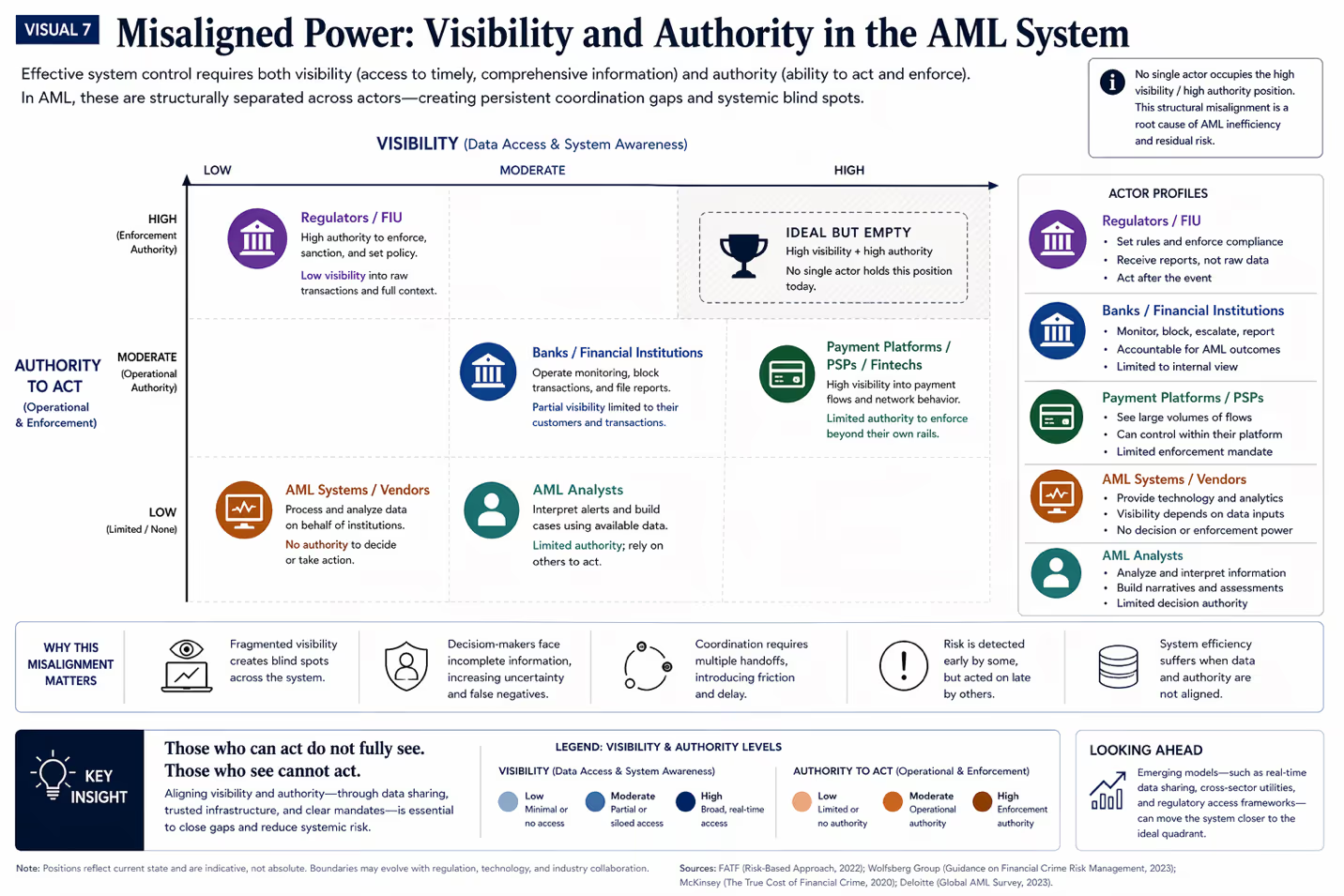
This misalignment is not the result of operational inefficiency. It is a consequence of how the system is organized. Data is distributed across institutions. Authority is defined through regulatory frameworks. Interpretation operates within these boundaries.
Coordination therefore becomes the central mechanism through which the system functions.
For the system to produce coherent outcomes, information must move across boundaries. Observations must be interpreted within context. Interpretations must support decisions. Decisions must reflect underlying activity with sufficient fidelity to meet regulatory and institutional requirements.
The effectiveness of this coordination determines system performance.
When visibility, interpretation, and authority connect effectively, decisions reflect activity with clarity. Reconstruction effort supports meaningful understanding, and outcomes are applied with confidence.
As coordination becomes more complex, additional effort is required to connect these elements. Reconstruction expands to bridge gaps in visibility. Decision-making becomes more dependent on interpretation under constraint. The system relies increasingly on its ability to align distributed capabilities.
This dynamic defines the operational limits of the system.
Improvements within individual components increase capability. Expanded data coverage improves visibility. Enhanced analytical methods improve interpretation. Refined frameworks strengthen decision-making. These developments extend the system’s reach.
System performance, however, depends on alignment.
The connection between visibility and authority, mediated through interpretation, defines how effectively the system can translate observation into action. Where this connection is constrained, additional effort is required to maintain coherence. Where alignment is achieved, the system operates with greater clarity and consistency.
The AML system operates through a defined sequence of transformation, reconstruction, and decision. Financial activity is translated into structured representations that enable monitoring at scale. Structured signals are expanded through reconstruction to form contextual understanding. Decisions apply that understanding within institutional and regulatory frameworks.
Each stage performs its function with depth and consistency. Transformation enables coverage. Detection supports systematic identification of patterns. Reconstruction forms context. Decision establishes outcomes that carry accountability.
Across this sequence, a consistent structure emerges.
Information is transformed to enable scale. Transformation introduces structural constraints on contextual completeness and continuity. Detection compresses structured representations into signals that can be processed consistently. Reconstruction expands these signals into contextual understanding through the assembly of information across sources. Decision applies this understanding within defined frameworks and determines exposure.
Effort concentrates where context is formed. Reconstruction defines the point at which structured signals are expanded into decision-ready understanding. This concentration of effort defines how operational capacity is consumed.
Cost follows this concentration. Investigation absorbs a significant share of resources because it requires time, expertise, and coordination across fragmented information. The economic structure of the system is therefore shaped by the effort required to form context.
Risk is organized through a different mechanism. It concentrates at the point of decision, where the system commits to an outcome. Decisions determine regulatory exposure, legal accountability, and reputational impact. Cost and risk therefore operate through distinct structures within the system.
At the same time, the system distributes its core capabilities across actors. Visibility is generated through data systems and institutional records. Interpretation is developed through analysis and reconstruction. Authority is exercised through institutional decisions and regulatory oversight. Each capability operates effectively within its domain.
These capabilities do not converge within a single actor. They are distributed across institutions, platforms, operational teams, and regulatory bodies. Each actor operates with a partial combination of visibility, interpretation, and authority.
This distribution introduces a coordination dynamic.
The system depends on the connection between what is observed, how it is understood, and how decisions are applied. Visibility must translate into interpretation. Interpretation must support authority. Decisions must reflect underlying activity with sufficient fidelity to meet institutional and regulatory requirements.
This connection is not inherent. It is constructed through coordination across distributed components.
Visibility and authority remain structurally misaligned. No actor combines full system visibility with full authority to act. Interpretation bridges this gap, operating within the constraints of fragmented data and defined scopes of action.
System performance therefore depends on alignment.
When visibility, interpretation, and authority connect effectively, the system produces decisions that reflect underlying activity with clarity. Reconstruction effort supports meaningful understanding, and outcomes are applied with consistency.
As coordination becomes more complex, additional effort is required to maintain this alignment. Reconstruction expands to bridge gaps in visibility. Decision-making becomes more dependent on interpretation under constraint. The system relies increasingly on its ability to connect distributed capabilities.
This dynamic defines how the system operates as a whole.
It scales through transformation. It forms understanding through reconstruction. It applies control through decision. It distributes capabilities across actors. It depends on alignment to connect these elements.
These characteristics are inherent to the system. They define how effort is applied, how resources are consumed, how risk is realized, and how outcomes are produced.
Understanding this structure provides a clear foundation for evaluating system performance. It clarifies where effort concentrates, how cost and risk are organized, how roles are distributed, and how decisions are formed.
It also establishes a consistent basis for assessing change.
Enhancements to individual components extend capability. Improvements in data, detection, and analytical methods increase coverage and precision. System performance, however, depends on how these improvements connect across stages and actors.
Alignment across transformation, reconstruction, and decision defines the system’s effectiveness.
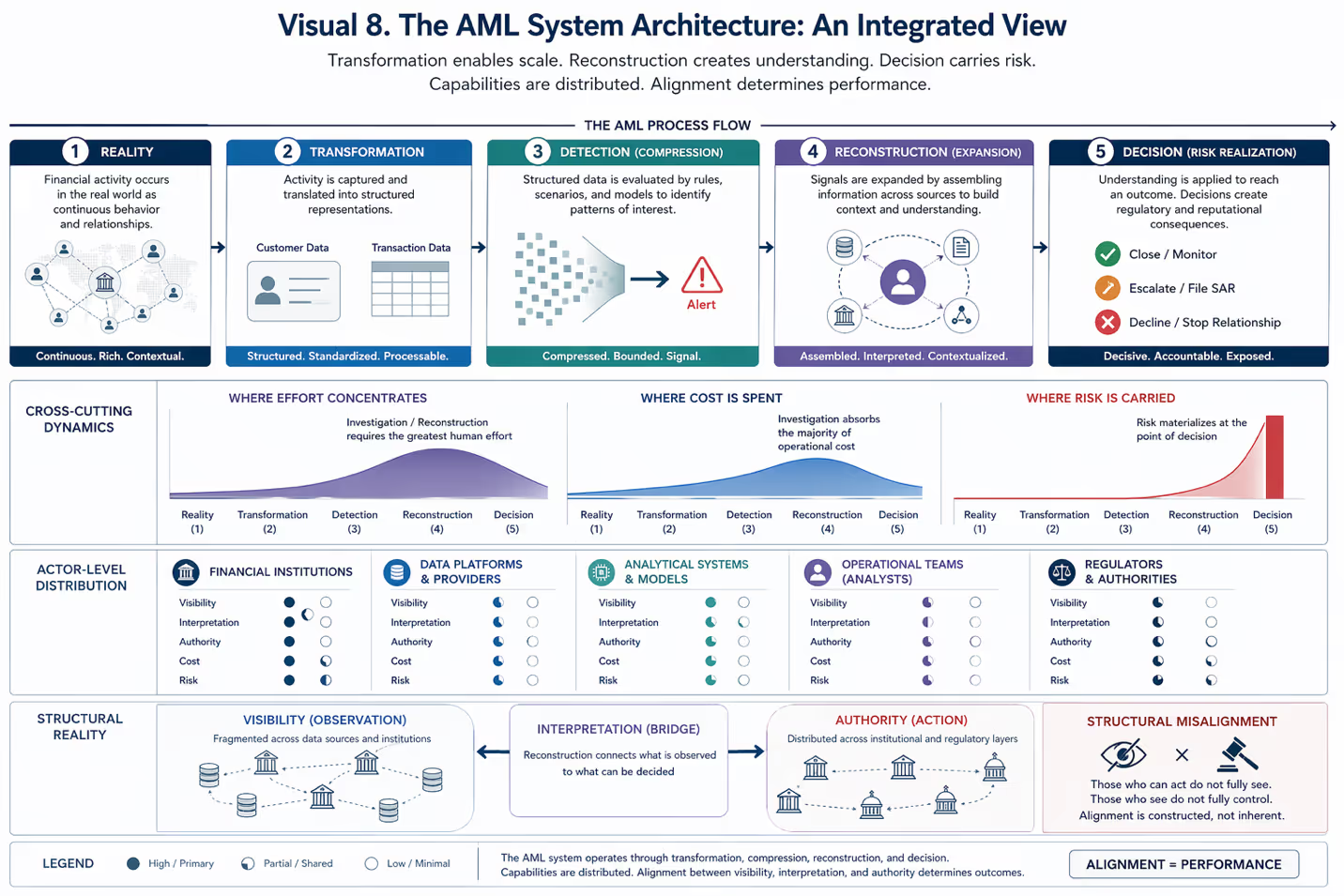
The structural characteristics of the AML system—transformation, reconstruction, distributed capability, and decision-based risk—define how effort, cost, and exposure are organized. These characteristics are observable in operational data across institutions and jurisdictions.
Quantification does not replace the structural model. It reinforces it by showing how these dynamics manifest at scale.
Detection systems operate with broad coverage across structured transaction and customer data. To maintain sensitivity to potential patterns of interest, detection parameters are typically calibrated to favor identification over exclusion.
This calibration produces high alert volumes.
Industry observations consistently indicate that the majority of alerts do not result in confirmed suspicious activity. False positive rates commonly exceed ninety percent in rule-based and hybrid monitoring systems, depending on calibration, product mix, and customer base.
This relationship reflects a structural condition. Detection expands coverage through signal generation. Reconstruction absorbs the resulting volume.
The volume of alerts therefore defines the volume of investigative workload.
Operational data shows that a significant share of AML resources is allocated to investigation and case handling. Estimates across large financial institutions indicate that a majority of AML operating expenditure is associated with alert review, investigation, and case management activities.
This concentration reflects the role of reconstruction within the system. Each alert initiates a process that requires:
The time required per case varies with complexity, customer profile, and data availability. Aggregate cost therefore scales with both alert volume and case complexity.
Detection infrastructure and data systems contribute to cost through technology investment, data acquisition, and model governance. These costs scale with system coverage and sophistication, but they do not dominate the operational cost structure.
Cost follows reconstruction.
The number of decisions taken within the system is significantly smaller than the number of alerts generated.
From a large base of monitored activity:
This progressive reduction reflects the filtering effect of detection and reconstruction.
Risk exposure is concentrated at the final stage of this sequence. Decisions determine whether regulatory obligations are met, whether suspicious activity is reported, and whether actions are defensible under scrutiny.
Regulatory frameworks require that decisions are supported by sufficient analysis, documentation, and reasoning. The consequences of these decisions extend beyond individual cases to institutional compliance posture and reputational standing.
A relatively small number of decisions therefore carries a disproportionate share of system-level risk.
The effort required for reconstruction is influenced by the distribution of data across systems and institutions.
Customer information, transaction records, external data sources, and analytical outputs are often stored in separate systems with different structures, access controls, and update cycles. Cross-border activity introduces additional fragmentation across jurisdictions and institutions.
This distribution increases the effort required to assemble a coherent view of activity. It also introduces variability in reconstruction time and quality across cases.
Operational metrics frequently reflect this variability through differences in:
Reconstruction load is therefore not uniform. It reflects both the structure of the data environment and the complexity of the activity under review.
The relationship between detection output, reconstruction effort, and decision quality defines measurable system performance.
Key indicators include:
These indicators reflect how effectively the system connects its stages and actors.
High alert volumes with constrained investigative capacity increase backlog and extend case handling time. Improved detection precision reduces unnecessary reconstruction effort. Enhanced data integration reduces the time required to assemble context. Consistent decision frameworks support defensibility and reduce variability in outcomes.
These relationships do not operate independently. They reflect the alignment of visibility, interpretation, and authority across the system.
Quantitative observations must be interpreted within the structural model.
High false positive rates reflect the role of detection as a coverage mechanism. Concentration of cost in investigation reflects the effort required to form context. Concentration of risk at decision reflects the point at which accountability is applied. Variability in case handling reflects data fragmentation and reconstruction complexity.
These patterns are not anomalies. They are consistent with the system architecture.
Quantification therefore provides evidence of how the system operates under real conditions. It reinforces the relationship between transformation, reconstruction, decision, and alignment.
The AML system operates through a defined structure of transformation, reconstruction, decision, and distributed capability. This structure determines how information is processed, how effort is applied, how cost accumulates, and how risk is realized.
Strategic positioning within this system is therefore not determined by participation alone. It is determined by how an actor engages with these structural dynamics.
Transformation and detection define the system’s ability to operate at scale. Improvements at this level expand coverage, refine signal generation, and increase the system’s capacity to identify patterns of interest.
Enhancements in data quality, integration, and analytical models improve the precision of structured representations and the effectiveness of detection mechanisms. These improvements influence how activity is observed and how signals are generated.
However, detection does not produce understanding. Its output directly determines the volume of reconstruction required. Increased sensitivity expands alert volume. Reduced precision increases the proportion of signals that require investigation without contributing to decision quality.
Leverage at this level therefore lies in shaping the relationship between coverage and signal quality.
Actors operating within this domain influence the system by determining what becomes visible and how efficiently signals translate into meaningful cases.
Reconstruction defines how the system forms understanding. It connects structured signals to contextual interpretation and supports decision-making.
Improvements in data accessibility, system integration, and analytical workflows reduce the effort required to assemble context. They increase the consistency and speed with which cases can be understood and evaluated.
Leverage at this level lies in reducing fragmentation.
Actors that improve the ability to:
directly reduce reconstruction effort and increase system throughput.
Because cost follows reconstruction, improvements in this domain have a direct impact on operational efficiency.
Decision-making defines how the system commits to outcomes. It determines how interpretation is translated into action and how risk is realized.
Improvements in decision frameworks increase consistency, clarity, and defensibility. They support the alignment between interpretation and regulatory expectations.
Leverage at this level lies in strengthening the connection between understanding and action.
Actors that define clear decision criteria, improve documentation standards, and ensure consistency across cases influence how risk is managed and how outcomes are evaluated.
Because risk concentrates at decision, improvements in this domain have a direct impact on regulatory exposure and institutional posture.
The system’s defining constraint is the alignment between visibility, interpretation, and authority.
Improvements within individual components extend capability. Expanded data increases visibility. Enhanced analytics improve interpretation. Stronger governance frameworks reinforce decision-making.
System performance, however, depends on how these capabilities connect.
Leverage therefore lies in alignment.
Actors that improve the flow of information between:
reduce the effort required to connect distributed capabilities and increase the consistency of outcomes.
Alignment reduces the need for reconstruction to compensate for fragmentation. It improves the translation of observation into action.
Different actors occupy distinct positions within the AML system. Each position defines access to data, role in interpretation, and scope of authority.
Financial institutions operate at the intersection of visibility, interpretation, and operational decision-making. Their leverage lies in managing reconstruction efficiency and decision quality within regulatory constraints.
Data platforms and analytical providers extend visibility and support detection and reconstruction. Their leverage lies in improving data coverage, integration, and analytical capability.
Operational teams shape interpretation and case-level understanding. Their leverage lies in consistency, expertise, and the ability to connect fragmented information.
Regulators define frameworks and apply authority across institutions. Their leverage lies in setting expectations, evaluating outcomes, and influencing system-wide behavior.
Strategic positioning depends on how an actor enhances its role within this structure and how it contributes to alignment across the system.
The system evolves through improvements in data, analytics, and regulatory frameworks. These developments expand capability at each stage.
At the same time, the underlying structure remains.
Transformation is required for scale. Reconstruction is required for understanding. Decision is required for accountability. Capabilities remain distributed across actors.
These characteristics define the limits within which the system evolves.
Advances in data sharing, integration, and analytical methods can reduce fragmentation and improve alignment. They can decrease reconstruction effort and increase consistency in decision-making.
They do not eliminate the need for reconstruction. They do not centralize visibility and authority within a single actor. They operate within the existing structure.
Strategic advantage therefore comes from operating effectively within these constraints.
The structural model clarifies where value can be created.
Investments that:
directly influence system performance.
These investments affect:
The system does not reward isolated improvements. It rewards improvements that connect stages and align capabilities.
© Thinsaction 2026 — No part of this article may be reproduced without attribution.